
Lutein & Zeaxanthin Guide — 10 mg and 2 mg: the Standard the Notifications Show
What the notification data shows
Aggregating the Consumer Affairs Agency’s notifications by functional ingredient name gives 529 for lutein and 371 for zeaxanthin. That is larger than any material we have covered so far — for reference, GABA stands at 1,485, inulin at 286 and L-carnitine at 9.
What matters is that the two are not used independently. Of lutein’s 529 notifications, 359 (68%) also name zeaxanthin. Seen from the other side, 359 of zeaxanthin’s 371 — meaning zeaxanthin is almost never used on its own.
Counting the content per daily intake reference makes the centre of the design obvious.
- Lutein 10 mg — 235 notifications (of 482 countable). Then 20 mg (94), 6 mg (27), 12 mg (20)
- Zeaxanthin 2 mg — 120 notifications (of 314). Then 10 mg (81), 4.08 mg (38)
So 10 mg lutein plus 2 mg zeaxanthin, a 5:1 ratio, is the de facto standard. Knowing that, you can work backwards to the material quantity before you choose a grade.
Withdrawals are also common here. 185 of lutein’s 529 and 127 of zeaxanthin’s 371 have been withdrawn — a withdrawal rate of about 35% in both cases. A large notification count does not mean an easy filing.
Free form versus esters — weights are not comparable
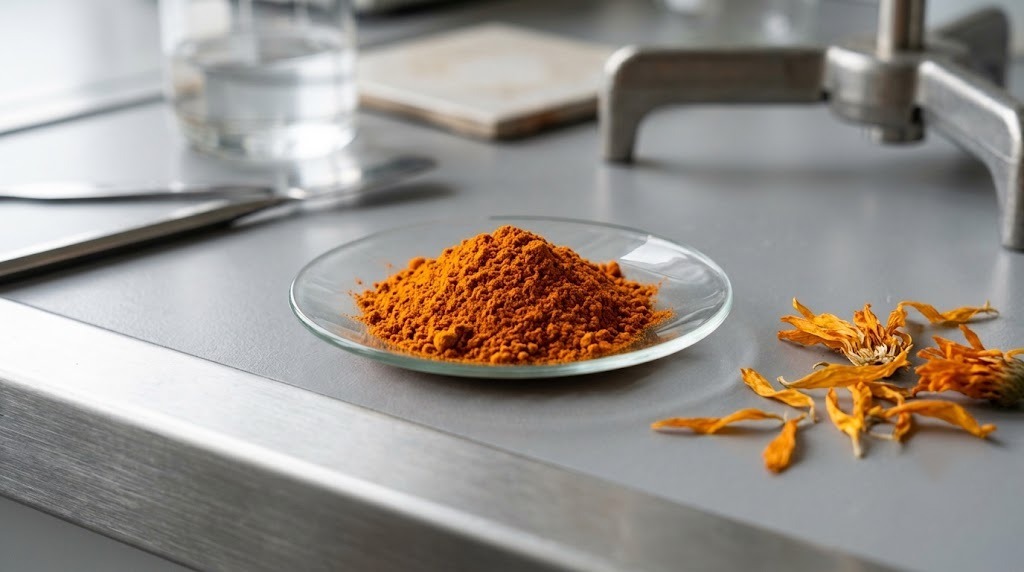
Lutein material is obtained from marigold (Tagetes erecta) flowers. From there it splits into two forms.
- Free form — lutein itself
- Ester form — lutein bound to fatty acids
The ester carries the fatty acid’s molecular weight on top, so the same charged weight delivers a different amount of lutein. Where an ester figure is presented as a free-lutein equivalent, the basis for that conversion has to be stated. Always check that the raw material name, the specification and the content declaration use the same terms.
The item we carry is specified at 5% content, but whether that 5% is on a free or ester basis changes the material weight needed to reach 10 mg. This is structurally the same problem as the salt forms of L-carnitine — there too, “as the salt” versus “as L-carnitine” changed the charged weight.
On absorption, animal data report higher uptake for the ester form, while most of the efficacy data has accumulated on the free form. If you are assembling a research review as the basis for a notification, which form the cited studies used is not a detail you can skip.
Zeaxanthin is usually added separately
Zeaxanthin is a structural isomer of lutein. Both share the formula C40H56O2, and they carry separate CAS numbers — lutein 127-40-2, zeaxanthin 144-68-3.
In marigold flowers lutein is the major carotenoid and zeaxanthin is present only as a minor accompanying component, a few percent. The 5:1 standard is therefore not a ratio you get by using marigold extract as it comes. It is a ratio you have to build, and that is worth knowing before you price the formulation.
The direction of the notified claims
The notified wording falls into two families.
- Macular pigment — “lutein and zeaxanthin act to increase and maintain the macular pigment of the eye…” (37 notifications share this wording)
- Light exposure — “expected to protect the eyes from light stimuli such as blue light…” (11)
Both treat the two compounds together as the functional ingredient. You cannot assemble the same wording from one of them alone. Permissible wording and the intake reference differ by notification, and notification is filed on the responsibility of the notifying party.
What to confirm on the specification
- Content basis — free form or ester. Settle this first
- Conversion basis — if an ester is shown as a free equivalent, the factor and its justification
- Zeaxanthin content — accompanying, or separately added
- Source — marigold flower; the extraction and saponification route
- Isomers and light control — carotenoids are sensitive to light and oxygen. Storage and packaging
- Dosage-form fit — being oil-soluble, the suitable form differs between tableting, powder filling and softgels
Discussing your requirement
For specifications, samples or a quotation, use the contact form and include the target lutein and zeaxanthin amounts and the dosage form. If the form is undecided, tell us the dosage form and intended quantity and we will propose one.
Related: eye & vision materials / functional ingredients
FAQ
Can lutein and zeaxanthin be used separately?
The scheme permits it, but in practice they are used together. Of lutein’s 529 notifications, 359 also name zeaxanthin; of zeaxanthin’s 371, 359 also name lutein. The notified wording also treats the two together as the functional ingredient.
What dose is standard?
The notification data shows lutein 10 mg (235) and zeaxanthin 2 mg (120) as the most common, a 5:1 ratio. The next most common pairing is 20 mg lutein with 10 mg zeaxanthin.
“5% content” is 5% of what?
Check that on the specification. Whether it is on a free or an ester basis changes the actual lutein delivered by the same 5%, because the ester carries the fatty acid’s molecular weight. Where a converted figure is shown, the factor and its basis must be stated.
Free form or ester — which should I choose?
Animal data report higher absorption for the ester, while most efficacy data has accumulated on the free form. Check which form the studies behind your notification used, and choose accordingly.
I heard withdrawals are common.
They are. 185 of lutein’s 529 notifications and 127 of zeaxanthin’s 371 have been withdrawn — about 35% in both cases. A large count does not mean an easy filing.
Can you supply small quantities for trials?
Yes. Please tell us the target lutein and zeaxanthin amounts and the dosage form.