
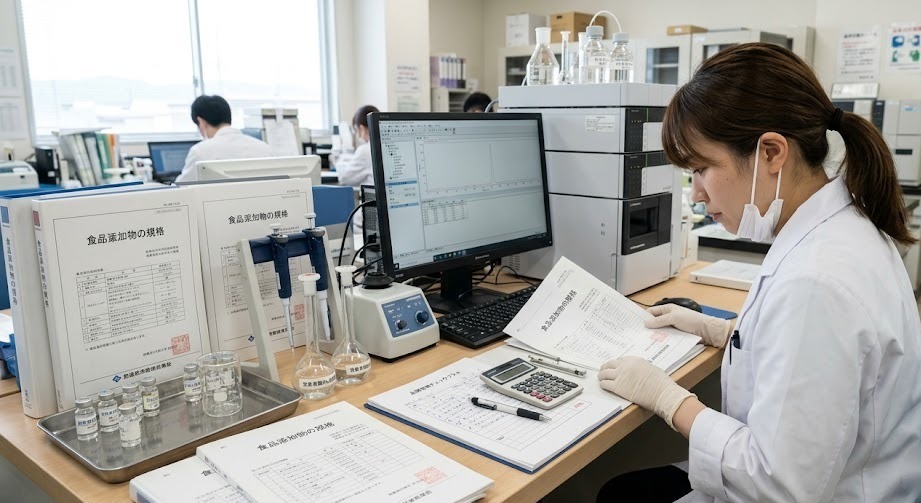
An introduction to “specifications,” “official standards,” and “CAS numbers” that often come up when handling food additives.
In shortThe Japanese Standards for Food Additives (the official standards book) defines the compositional specifications, manufacturing standards, and test methods for food additives used in Japan. Whether a material “conforms to the official standards” is the benchmark for quality, and the CAS number is checked alongside as a unique identifier for the substance.
Japanese Standards for Food Additives
This is the standard reference defining the specifications and test methods for food additives used in Japan. Conformance indicates food-grade quality.
The Role of CAS Numbers
The CAS registry number identifies a chemical substance unambiguously, regardless of naming variations, making it a common language for sourcing and regulatory checks.
Related category: Food Additives
FAQ
What are the official standards for food additives?
They are public standards set by the Ministry of Health, Labour and Welfare, compiling compositional specifications and test methods for food additives. Food-additive-grade materials are expected to conform to them.
What is the difference between “specification” and “grade”?
A specification refers to the quality criteria to be met (purity, content, impurity limits, etc.), while grade refers to the use category (food/pharmaceutical/reagent, etc.). Confirm both the right grade and spec conformity for the intended use.
Where can I find the CAS number?
It is listed on the material COA (Certificate of Analysis), spec sheets, and manufacturer documents. The FONTIA catalog also lists the CAS number for each item.