
How to Read a COA (Certificate of Analysis)|Items to Check in B2B Sourcing
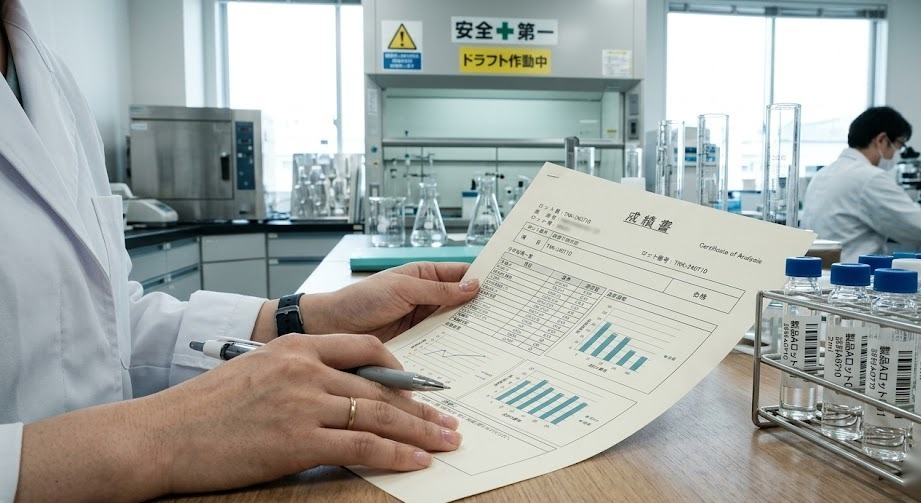
Key items on a COA
- Product name, lot number, manufacturing date / expiry
- Assay / potency
- Description (appearance, color, odor)
- Purity tests (heavy metals, arsenic, residual solvents)
- Microbial tests (total plate count, coliforms, etc.)
- Specification (spec) vs. actual result
How to read it
Match each item’s “spec” against its “result” one by one and confirm everything is within specification. Whether the COA’s lot number matches the actual delivery is also an important check. English COAs are common for imported materials; once you understand the items, there is no practical issue.
Sourcing in practice
Evaluate with a sample and COA first, then obtain and keep a COA for each lot in mass production. FONTIA provides spec sheets and COAs individually upon request.
FAQ
What is the difference between a COA and a spec sheet?
A spec sheet shows the product’s standard specification; a COA shows the measured results for that lot, proving it meets the spec.
Do I need a COA for every lot?
For quality assurance, obtaining one per lot is recommended. It also supports traceability.
Is an English COA acceptable?
It is common for imported materials. As long as you understand the items (assay, heavy metals, etc.), there is no practical issue.