
Taurine Ingredient Guide — Uses, Specs, and Sourcing
What taurine is
Taurine (2-aminoethanesulfonic acid) carries a sulfonic acid group rather than a carboxyl group, so strictly speaking it is not an amino acid but an amino-acid-like compound. It is not incorporated into protein.
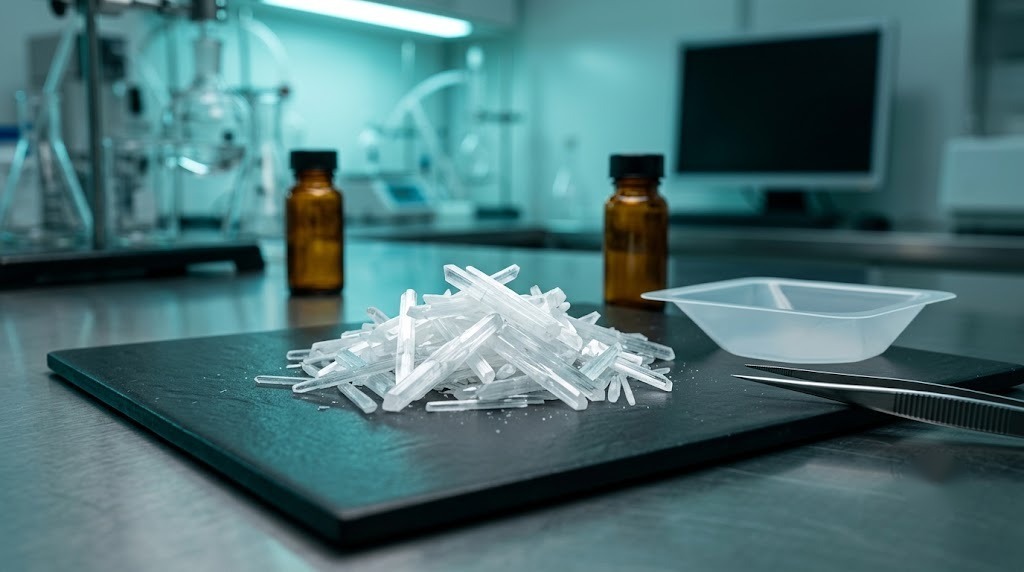
It is supplied as a white crystalline powder with high water solubility and good stability across heat and pH. Unlike GABA it is not notably hygroscopic, which makes powder filling and tableting comparatively straightforward. It handles well in beverages, powders and tablets alike.
Where the volume actually goes
Taurine is best known as an energy drink ingredient, but in raw material terms there is a second major outlet: pet food, and cat food in particular.
Cats synthesise very little taurine endogenously and must obtain it from the diet. Complete and balanced cat foods are therefore formulated with taurine by design, which produces steady feed-additive demand independent of the beverage cycle. The taurine FONTIA supplies is mainly quoted into that feed additive channel.
Human nutrition demand continues in sports nutrition applications.
Food grade vs. feed grade — decide this first
The most common cause of rework when sourcing taurine is an unconfirmed grade. Two lots can both read “taurine, 99% min” and still sit under different legal frameworks, with different required documentation and different expectations of the manufacturing site.
- Food grade — handled under food sanitation law. If the finished product is a food, the ingredient must qualify accordingly
- Feed grade — in Japan this falls under the Feed Safety Act. Substances designated as feed additives are used within the designated scope and specification
State whether the finished product is for humans or animals when you request a quotation. Without it you may receive a specification and lot that cannot be used, and only discover the mismatch after sample evaluation is complete.
What to check on the specification
- Assay — 98.5% min and 99% min are the usual commercial levels
- Production route — synthetic dominates food and feed use; naturally derived material changes both availability and price substantially
- Heavy metals and arsenic — confirm whether a compendial or in-house standard applies
- Microbiology — total plate count, coliforms, yeast and mould
- Particle size — governs dissolution rate in beverages and flow in powder and tablet operations
- Loss on drying — the basis for assay calculation
Because taurine is not a hygroscopicity problem, particle size tends to be specified late or not at all. It affects dissolution and fill accuracy, so state your target grind early if the application is already fixed.
Sourcing checklist
- Grade confirmed — as above, this comes first
- Country of origin and manufacturing site — synthetic production is concentrated in a limited number of plants, so knowing the source supports continuity
- Minimum order quantity — whether small lots are available at prototype stage
- Specification and CoA — per-lot CoA availability and whether the format fits your incoming inspection
FONTIA supplies from prototype-scale lots upward. For specifications, samples or a quotation see the taurine product page or use the contact form. Related: amino acid ingredients.
FAQ
Is taurine an amino acid?
It carries a sulfonic acid group, so strictly it is an amino-acid-like compound and is not built into protein. It is commonly grouped with amino acids in nutrition contexts.
Should I buy food grade or feed grade?
It depends on whether the finished product is for humans or animals. The governing law and required documents differ, so state this when requesting a quotation.
Is naturally derived taurine available?
Food and feed applications use synthetic material almost exclusively. Naturally derived taurine differs sharply in availability and price, so confirm whether your claim actually requires it.
Does taurine need moisture protection?
It is not strongly hygroscopic. Normal sealed storage is generally sufficient, which makes it easier to handle than many amino acid materials.
Are small lots available for prototyping?
Yes. Tell us the quantity, the application (human or animal) and your target timing.