
Erythritol Guide — The Sugar Alcohol That Is Not an Additive
What erythritol is
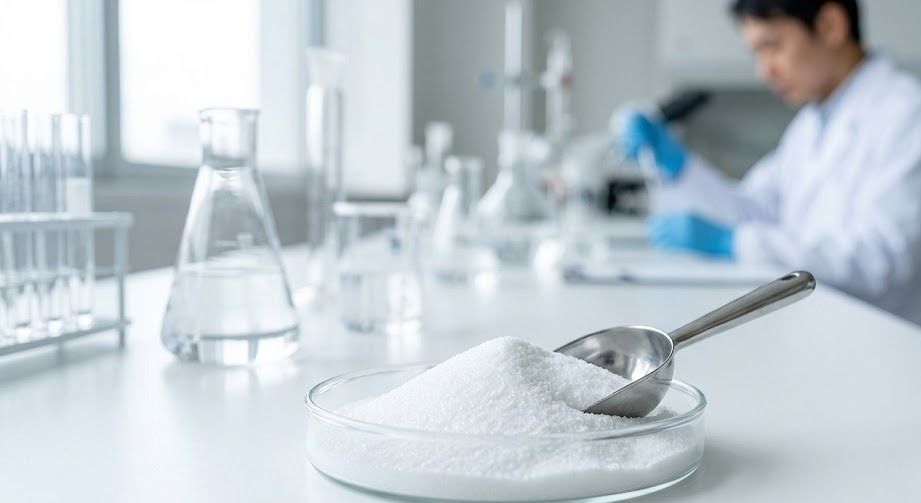
Erythritol is a sugar alcohol with about 70% the sweetness of sugar and nearly zero calories. It is largely excreted unmetabolized, so its impact on blood sugar is said to be small. Industrially it is produced by fermentation from glucose.
The other defining property is its endothermic dissolution. The cooling sensation on the tongue comes from this. In mints and tablets that is an asset; where a cooling effect is unwanted, the formulation has to round it off with other sweeteners.
Not an additive — the category difference bites
“Sugar alcohols” are often treated as one bucket, but their legal handling is not uniform. The designated additives list carries xylitol (No. 110) and D-sorbitol (No. 242). Erythritol matched none of the lists we collect and cross-check: 476 designated additives, 327 existing additives, 62 general food-item additives and 3,181 flavouring substances. It is handled as a food.
The difference shows up in both documentation and labelling.
- Ingredient name labelling — where Japanese labels separate additives with a slash, which side the item sits on changes
- The standard the specification references — whether compendial compliance (Japan’s Specifications and Standards for Food Additives) is the right thing to require
- Tests to request from the supplier — asking on one template “because they are both sweeteners” leaves fields that cannot be filled
This is the point most often missed in projects that switch several sweeteners at once. Replacing xylitol with erythritol is a documentation question as much as a physical-properties question.
It is not a function-claim material
Aggregating the Consumer Affairs Agency’s Foods with Function Claims notifications by functional ingredient name, there are no notifications naming erythritol as the functional ingredient — none in the last twelve months, and none in the twelve before that. The literature itself is not thin (1,281 papers on J-STAGE, 152 from 2020 onward), but the material’s place is a general-purpose ingredient carrying sweetness and texture, not a claim.
Its role in product planning is therefore not the headline but the base that keeps texture and the sweetness profile intact while sugar comes out. The claim is carried by a different functional ingredient; erythritol works on the formulation side. Without that separation, the notified functional ingredient and the formulation design end up pulling against each other.
Sourcing points
- Particle size — granular or fine. This drives dissolution rate, powder flow and mouthfeel. If the application is settled, tell us at the outset
- Sweeteners used alongside — combination with high-intensity sweeteners is standard. Onset and lingering sweetness change, so choose particle size on the assumption of the combination
- Tolerance for the cooling effect — an asset or a defect depending on the application. Work back from it to the maximum inclusion rate
- Production method and feedstock — fermentation-derived. The feedstock (corn and the like) bears on allergen labelling and non-GMO confirmation
- Packaging and hygroscopicity — factor in storage space and handling after opening
On enquiries outside food use
We receive enquiries about erythritol as a cosmetic ingredient. It is used in cosmetics as a humectant, but cosmetics fall under a different law in Japan (the Pharmaceuticals and Medical Devices Act), with different required specifications, tests and documentation. What FONTIA supplies is food grade. If you are considering a cosmetic application, say so in your enquiry and we will answer on suitability.
What FONTIA supplies
FONTIA supplies erythritol (CAS 149-32-6), from small trial quantities upward. For specifications, samples or a quotation, use the contact form and include the application, preferred particle size and the sweeteners it will be combined with.
Related: sweeteners
FAQ
Is erythritol a food additive?
It appears in neither of the lists we maintain — 476 designated additives and 327 existing additives. It is handled as a food. Xylitol (designated additive No. 110) and D-sorbitol (No. 242) are additives, so the handling differs even within sugar alcohols.
How does it differ from sugar?
About 70% the sweetness with nearly zero calories. It also dissolves endothermically, which gives the characteristic cooling sensation.
Can it be the functional ingredient in a Foods with Function Claims product?
There are none — no notifications name erythritol as the functional ingredient, either in the last twelve months or the twelve before. In practice the claim is carried by another ingredient while erythritol supports sweetness and texture.
Impact on blood sugar?
Said to be small as it is largely unmetabolized, but product labelling must follow the applicable regulations.
Can it be combined with other sweeteners?
Yes, and combination with high-intensity sweeteners is standard practice for balancing the sweetness profile. Choose particle size on that assumption.
Can it be used in cosmetics?
Cosmetics fall under the Pharmaceuticals and Medical Devices Act, with different required specifications and documentation. FONTIA supplies food grade; tell us if the application is cosmetic.