
Inulin Guide — 750 mg or 4.5 g: the Dose Decides the Dosage Form
What inulin is
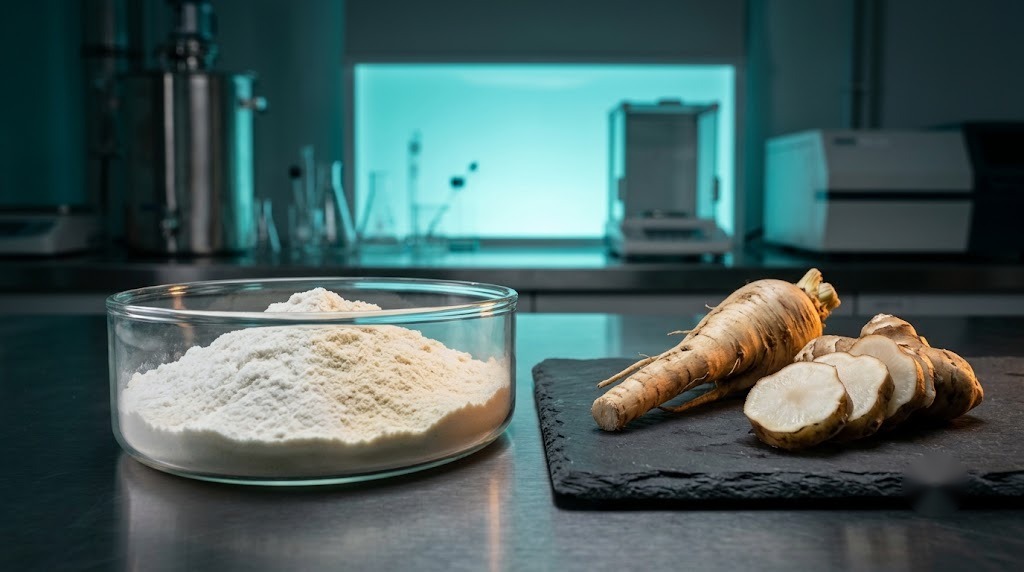
Inulin is a polysaccharide of linked fructose units, classified as a soluble dietary fibre. It occurs in Jerusalem artichoke, chicory and burdock. Human digestive enzymes do not break it down, so it reaches the large intestine and serves as a fermentation substrate for gut bacteria. J-STAGE returns 2,655 papers (257 from 2020 onward).
It is not a food additive. Inulin appears in neither of the lists we maintain — 476 designated additives and 327 existing additives — and is handled as a food raw material. (Chicory colour, made from the root of the same Cichorium intybus, is listed as a general food-item additive used as a colouring; that is a separate item.)
Two claim directions — blood glucose and gut environment
Aggregating the Consumer Affairs Agency’s notifications by functional ingredient name, inulin totals 286 notifications across 143 companies (241 alone, 45 in combination). The notified wording runs in two directions.
- Blood glucose — “a function of suppressing the rise in blood glucose after a meal” (27 notifications)
- Gut environment and bowel movement — “used for fermentation and growth by bifidobacteria in the gut, improving the gut flora and thereby improving bowel movement in those prone to constipation” (17)
The standout combination is with bifidobacteria — Bifidobacterium BifiX (B. lactis GCL2505) paired with inulin appears in 13 notifications. Inulin is the fermentation substrate and the bacteria the headline, a division of labour that also works as positioning. Other pairings include chlorogenic acid, luteolin, spore-forming lactic acid bacteria, GABA, ellagic acid and banaba leaf-derived corosolic acid.
Permissible wording and the daily intake reference differ by notification, and notification is filed on the responsibility of the notifying party.
An eleven-fold spread in dose — 750 mg or 4.5 g
Notified content per daily intake reference, most common first (notation variants combined):
- 4.5 g — 66 notifications
- 750 mg — 25+
- 8.1 g — 13
- 5.2 g — 8
750 mg against 8.1 g is close to eleven-fold. This is not a cost question — it is a question of whether the dosage form works at all.
- Gram-scale (4.5 g, 5.2 g, 8.1 g) — will not fit a tablet or capsule. Powder sticks, beverages, or formats meant to be dissolved are effectively the only options. Sachet design and solubility become the main considerations
- 750 mg — fits a tablet or capsule. The data suggests this level is chosen for formulations combined with other ingredients
This decision has to be made before choosing the material. Request quotations without a settled dosage form and the order of magnitude of your requirement stays undefined, which makes comparison impossible.
For scale: ellagic acid, covered the same day, has a standard daily intake of 3 mg. Against inulin’s 4.5 g that is a 1,500-fold difference — two “functional ingredients” whose design premises have nothing in common. There are in fact notifications combining the two, at inulin 750 mg with ellagic acid 3 mg.
Source and purity — Jerusalem artichoke and chicory
FONTIA carries two.
- Inulin (CAS 9005-80-5)
- Inulin (from Jerusalem artichoke) — inulin 90.0% min.
At gram-scale inclusion, a difference in purity becomes a difference in charged weight. Delivering 4.5 g as inulin means charging 5.0 g of a 90% grade. That works directly on sachet volume, so always confirm whether the specification figure is “as inulin” or “as the product”.
Some notifications also write the source into the ingredient name, such as “Jerusalem artichoke-derived inulin”. If you are designing against an existing notification, check first whether your material matches that naming.
What to confirm on the specification
- Inulin content and its basis — “as inulin ○% min.” or “as the product”. At gram scale this feeds straight into charged weight
- Source — Jerusalem artichoke, chicory or other. Bears on the notified ingredient name
- Solubility — the critical item for beverage and powder-stick use. Confirm dissolution temperature and dispersibility
- Particle size — affects clumping and flow during sachet filling
- Degree of polymerisation (DP) — bears on fermentation behaviour. Worth confirming if the claim is about gut environment
- Hygroscopicity and packaging — gram-scale use means significant storage volume; factor in handling after opening
Discussing your requirement
For specifications, samples or a quotation, use the contact form and include the intended daily intake, dosage form (powder / beverage / tablet) and claim direction (blood glucose or gut environment). If a combination with bifidobacteria or another ingredient is planned, tell us the partner and we can cover the formulation points too.
Related: functional ingredients
FAQ
What daily intake is typical?
4.5 g is the most notified (66), followed by 750 mg (25+), with designs at 8.1 g and 5.2 g as well — close to an eleven-fold spread. Grams or hundreds of milligrams changes the dosage form fundamentally.
Can it go into a tablet?
750 mg fits; 4.5 g and above will not fit a tablet or capsule. Powder sticks and beverages — formats meant to be dissolved — are effectively the only options.
What claims are being notified?
Two directions: suppressing the post-meal rise in blood glucose (27 notifications), and improving bowel movement in those prone to constipation through a better gut flora (17).
Can it be combined with bifidobacteria?
Of the 45 combination notifications, pairing with Bifidobacterium BifiX (B. lactis GCL2505) is the most common at 13. Inulin acts as the fermentation substrate and the bacteria as the headline.
How does the 90% grade differ from the standard grade?
At gram-scale inclusion, purity translates directly into charged weight — delivering 4.5 g as inulin takes 5.0 g of a 90% grade. Because this affects sachet volume, always confirm the basis of the specification figure.
Is it a food additive?
No. It appears in neither of the lists we maintain — 476 designated additives and 327 existing additives — and is handled as a food raw material.